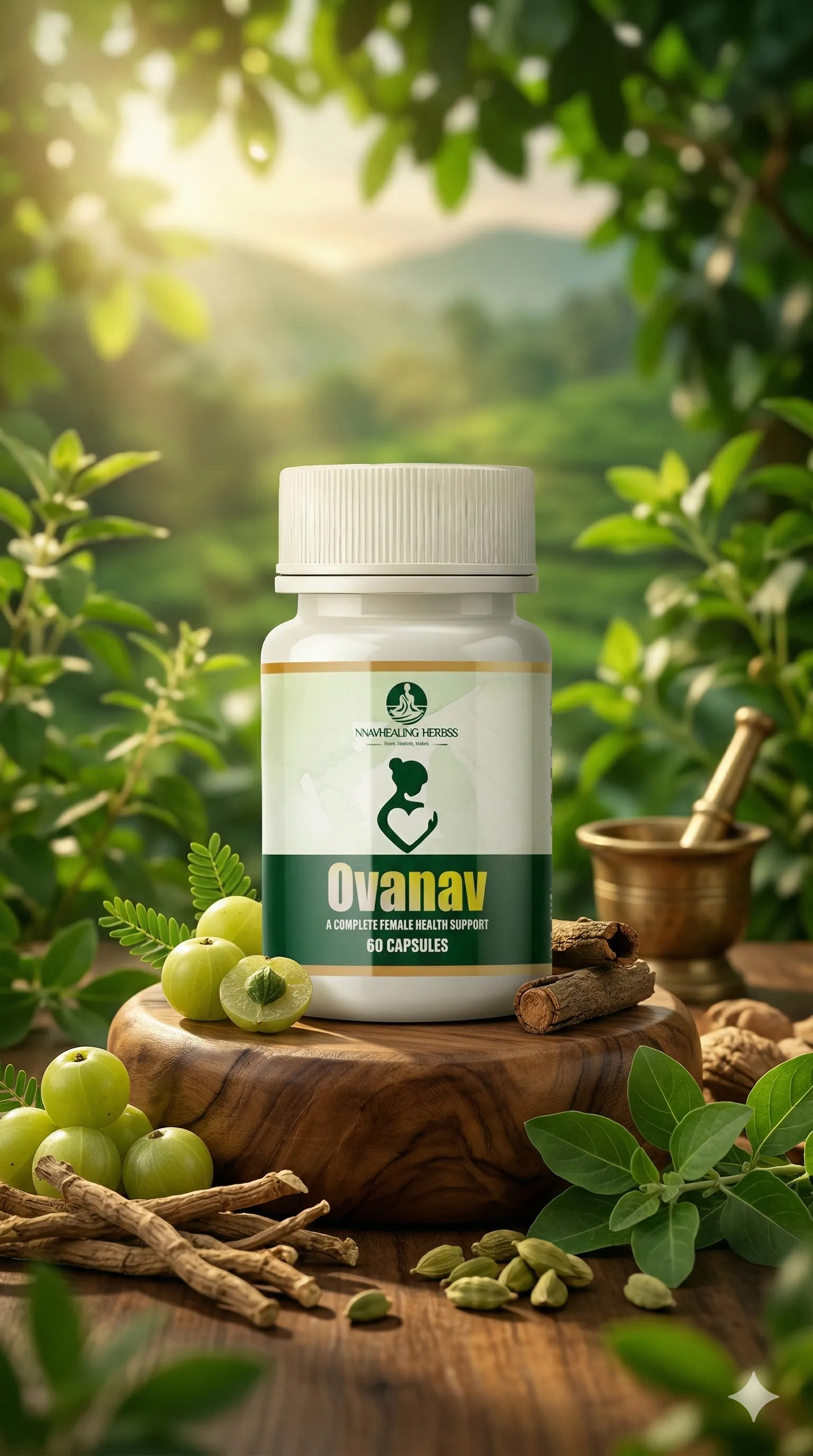
Ovanav Capsules are the formulation I reach for most often in clinical practice — for PCOS, irregular cycles, perimenopause, and postpartum recovery. Every ingredient was chosen deliberately. This is what each one does, and why the combination holds together as a classical formula.
Shatavari — 300 mg, 60% of the formula
Asparagus racemosus is the foundation. In the Stri-roga (women's disease) tradition of Ayurveda, Shatavari is the primary rasayana for the female reproductive channel — nourishing, cooling, and deeply tissue-building.
At 300 mg per capsule, it reaches a therapeutic dose. Many commercial women's health supplements include Shatavari at 50–100 mg — quantities too small to have a meaningful tissue effect. Ovanav is built around the understanding that Shatavari needs to dominate the formula, not appear as a supporting herb.
Its primary mechanism is nourishment of rasa dhatu — plasma and lymph — the first tissue in the Ayurvedic chain. When rasa is depleted (as it consistently is in women with PCOS, irregular cycles, and postpartum depletion), the downstream tissues that depend on it — blood, reproductive tissue, bone — all suffer. Rebuilding rasa is the upstream fix.
Ashoka bark — 75 mg, 15%
Saraca asoca is the classical uterine tonic. The name means "without grief" — a traditional acknowledgement of its effect on uterine pain, irregular flow, and menstrual distress.
Ashoka works directly on the uterine muscle and endometrial lining. Clinical studies have demonstrated its effect on normalising menstrual flow in women with menorrhagia (heavy periods) and its anti-oestrogenic activity, which is relevant in conditions like PCOS and fibroids where oestrogen excess is a component.
At 75 mg alongside Shatavari, it addresses the uterine environment rather than just the hormonal signal — which is why the combination produces more complete cycle regularisation than either herb alone.
Lodhra bark — 40 mg, 8%
Symplocos racemosa is astringent, cooling, and specifically used in Ayurveda for conditions involving excess discharge, irregular menstruation, and leucorrhoea. Its astringency supports tissue tone in the reproductive channel — tightening and firming where chronic depletion has left things loose and irregular.
It is the herb in Ovanav that most patients do not notice — because it works quietly at the tissue level, without a dramatic symptomatic effect. But remove it from the formula and the results are measurably less consistent in women with heavy or prolonged periods.
Ashwagandha — 30 mg, 6%
Withania somnifera is the adaptogen — the herb that addresses the nervous system and stress-hormone axis. At 30 mg it is a supporting dose, not a therapeutic one. Its function in Ovanav is to prevent cortisol-mediated disruption of the ovarian cycle.
Elevated cortisol is one of the most common upstream causes of disrupted ovarian function in the women I see. Long working hours, poor sleep, chronic low-grade anxiety — all of these elevate cortisol, which suppresses LH and disrupts ovulation. Ashwagandha does not sedate or relax in the conventional sense. It steadies the stress response so the reproductive axis is not constantly interrupted by it.
What to expect over 90 days
The first month usually produces changes in energy, sleep quality, and pre-menstrual symptoms. These are the Ashwagandha and Shatavari effects — improvements in rasa and the nervous system — that arrive relatively quickly.
The second month typically shows the first cycle changes: a shift in duration, a reduction in pain, or a first regular cycle after a period of irregularity. This is the Ashoka effect becoming measurable.
By the third month, the pattern is usually established enough to assess. In my clinical experience, approximately 70–75% of patients with irregular cycles show meaningful regularisation by this point. The remaining patients require either a dosage adjustment or the addition of Gynonav Syrup to address blood-level depletion that Ovanav alone is not sufficient to correct.
Ovanav is a classical formulation — it builds slowly, at the level of tissue. It is not a hormonal intervention and does not produce rapid hormonal suppression. What it produces is a steadier, more nourished reproductive system that is capable of regulating itself.

