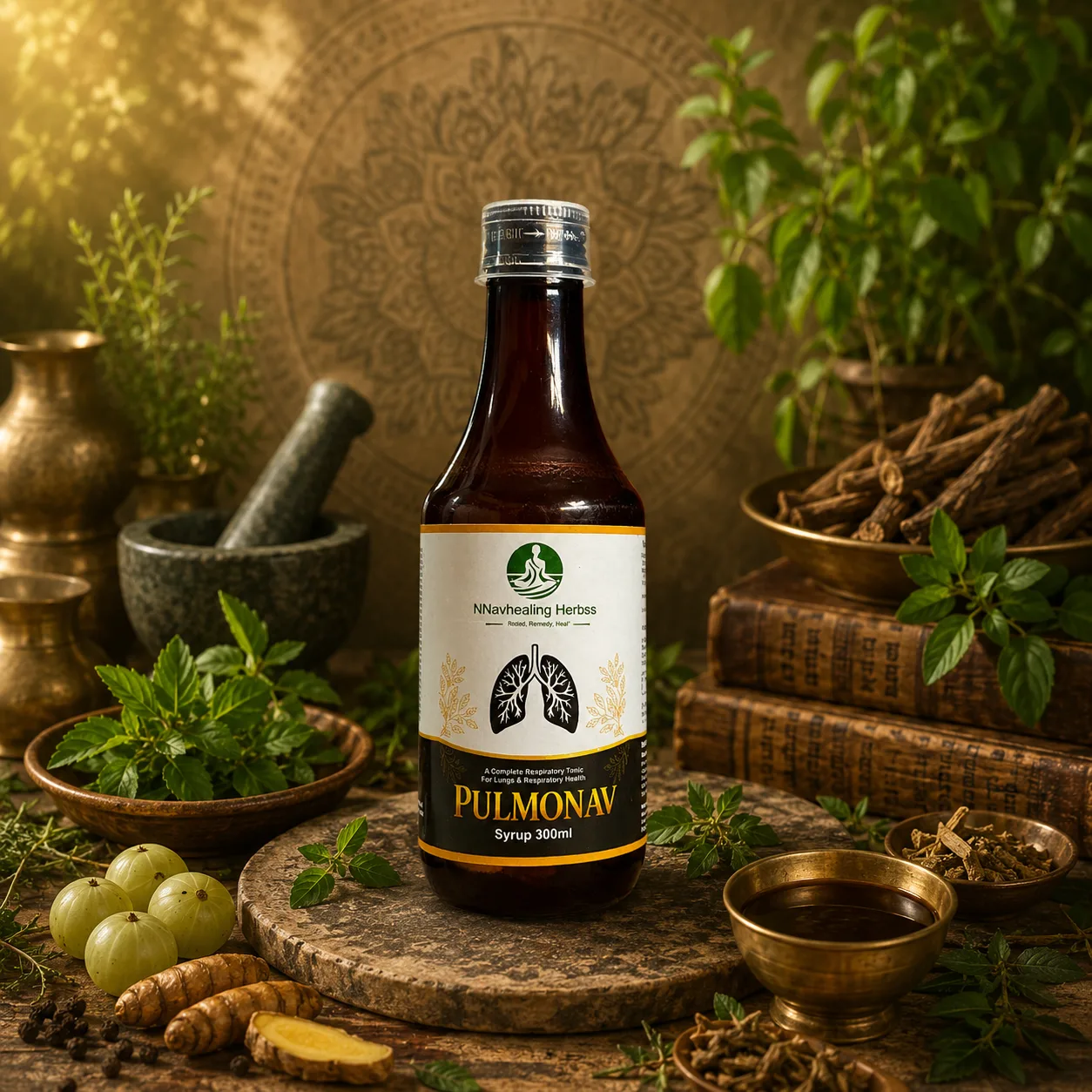
Pulmonav Syrup contains 28 herbs. The number is not marketing — it reflects the classical understanding that the pranavaha srotas (respiratory channel) is one of the most complex systems in the body, requiring a broad and layered formula to support it comprehensively.
This article covers the four primary herbs and what the formula achieves as a whole.
Why a syrup for the lungs
In classical Ayurvedic pharmacology, the pranavaha srotas is best reached by liquid preparations — particularly syrups with honey as the base. Honey (madhu) is classified as a yogavahi: a substance that carries other herbs deeper into the tissues than they could penetrate alone. For lung formulations, honey carries the active herbs into the bronchial mucosa, where they are most needed.
The classical preparations for respiratory disease — arishtas, asavas, and honey-based lehyams — have been liquid for thousands of years. Pulmonav follows this tradition. A capsule would require digestion before reaching the lungs. The syrup, especially with honey, begins working on the mucous membranes from the moment it is swallowed.
Amla — the immune rasayana
Emblica officinalis (Indian gooseberry) is present at 50 mg and serves as the immune foundation of the formula. Amla is the most important single rasayana in classical Ayurveda — a tridoshic herb that nourishes all seven dhatus, supports ojas, and provides extraordinary antioxidant protection to every tissue it reaches.
For the lungs specifically, Amla is documented to reduce oxidative damage to lung tissue, support alveolar integrity, and improve the body's resistance to recurrent respiratory infections. In patients who suffer three or four respiratory infections each year — a common pattern I see in those with compromised pranavaha srotas — consistent Amla supplementation reduces infection frequency measurably over a six-month period.
Giloy — the immunomodulator
Tinospora cordifolia (heart-leaved moonseed) is Ayurveda's premier immunomodulator — a herb that does not stimulate or suppress the immune system but regulates it. This is the critical distinction for respiratory disease: an over-reactive immune system (as in allergic asthma and allergic rhinitis) needs modulation, not stimulation.
Giloy achieves this through its effect on macrophage activity and T-cell function. It reduces the hyper-reactivity of the immune response to airborne triggers while simultaneously improving the body's ability to clear genuine respiratory infections. The result, over sixty to ninety days of consistent use, is a respiratory system that responds proportionately — strongly when needed, quietly when not.
Mulethi — the soother
Glycyrrhiza glabra (liquorice root) is the demulcent at the heart of Pulmonav. Where Vasa clears and Giloy modulates, Mulethi soothes and rebuilds the respiratory mucosa. Its glycyrrhizin content provides anti-inflammatory activity directly at the bronchial lining; its mucilaginous compounds coat and protect irritated mucous membranes.
For patients with dry, persistent, or irritating cough — the kind that lingers after a respiratory infection or accompanies allergic rhinitis — Mulethi is the herb that provides the most immediate relief. It quiets the cough reflex by soothing the irritated nerve endings in the bronchial mucosa rather than suppressing them centrally.
Vasa — the bronchial herb
Adhatoda vasica (Malabar nut) — the same herb that anchors Nav Allergy Capsules — is present in Pulmonav as the bronchial clearing agent. In the context of a tonic formula, Vasa ensures that the nourishment and immune support provided by the other herbs reaches open, clear airways rather than being impeded by mucus accumulation or bronchospasm.
The combination of Vasa (clearing), Mulethi (soothing), Giloy (modulating), and Amla (nourishing) covers all four requirements for comprehensive respiratory support: clearance, protection, immune balance, and tissue nourishment.
Pulmonav and Nav Allergy together
Pulmonav is a broad respiratory tonic — a formula for long-term lung health and immune steadiness. Nav Allergy Capsules are a targeted anti-allergic formula addressing the blood and immune layers of allergic disease.
For patients with significant allergic rhinitis or allergic asthma, I frequently prescribe both simultaneously. Pulmonav supports the respiratory channel as a whole; Nav Allergy addresses the specific allergic hypersensitivity. The two formulas complement each other without overlap in their primary mechanisms, and the combination produces faster and more complete results than either alone.

